
Wellbeing: Setting a Weekly Time Budget
A weekly time budget is easier to keep than a daily limit, because it survives a busy Tuesday. Set a number in minutes, track it loosely across seven days, and the habit stops being a series of small decisions. Using an illustrative six-week ramp of 28 to 34 sessions, at 15 minutes each, a moderate budget lands somewhere near 85 minutes a week.

Key takeaways
- Budget in minutes a week, not sessions a day, so a missed evening does not break the plan.
- Track loosely: the number of sessions and a rough length for each is enough.
- Expect a ramp. Six weeks often climb from 3 sessions to about 34 cumulative, which is why budgets should be reviewed monthly.
- Put the review in the calendar. An untracked budget drifts upward within a fortnight.
Why weekly beats daily
Daily limits fail for ordinary reasons. A long day at work, an early start, a household evening - any of them turns an unspent daily allowance into a missed target, and missed targets are what make people abandon a plan. A weekly figure absorbs all three without needing to be renegotiated.
Weekly budgets also match how the habit actually behaves. Sessions cluster: two or three per week is common in a quiet month, and eight in a busy one. A weekly number describes that pattern; a daily one argues with it.
The third reason is measurement. Minutes are easier to estimate honestly than message counts, because you know when you sat down and when you stopped. Estimation error of a few minutes per session is acceptable, and the weekly total is still accurate enough to be worth acting on.
How to set the number
Start with what you already do rather than with an aspiration. Log two weeks of sessions with a rough length for each, add the minutes, and divide by two. That figure is your current budget whether or not you planned it, and it is the only honest starting point.
Then decide whether to keep it, trim it, or make it more predictable. Most readers find their total is lower than they feared but more scattered than they would like, which is a scheduling problem rather than a moderation one. Moving three short sessions into two longer ones usually improves the experience without changing the total.
Finally, write the number where you will see it. A budget that lives only in your head is renegotiated every evening, and each renegotiation is a small decision you have to make again rather than one you already made.
A useful trick is to convert the number into weeks rather than evenings. If your figure is 90 minutes, that is six 15-minute sessions or three half-hour ones, and deciding in those terms at the start of the week removes the nightly negotiation entirely. Readers who prefer longer arcs can hold the same 90 minutes as two 45-minute sessions, which usually suits a narrative mood better without costing an extra minute.
| Budget band | Sessions a week | Minutes a week at 15 minutes a session | Review cadence |
|---|---|---|---|
| Light | 2 to 3 | About 45 | Monthly |
| Moderate | 5 to 6 | About 85 | Monthly |
| Heavy | 8 or more | About 120 upwards | Fortnightly |
| Session length | Any | 15 minutes as the illustration | Recheck if sessions grow |
| Missed week | Zero | Carry nothing over | Restart the week clean |
The last row is the one that keeps a weekly budget alive. Carrying unused minutes forward turns a plan into a debt, and a debt is exactly what people abandon. Each week starts at the same number.
Worked example: a six-week ramp in minutes
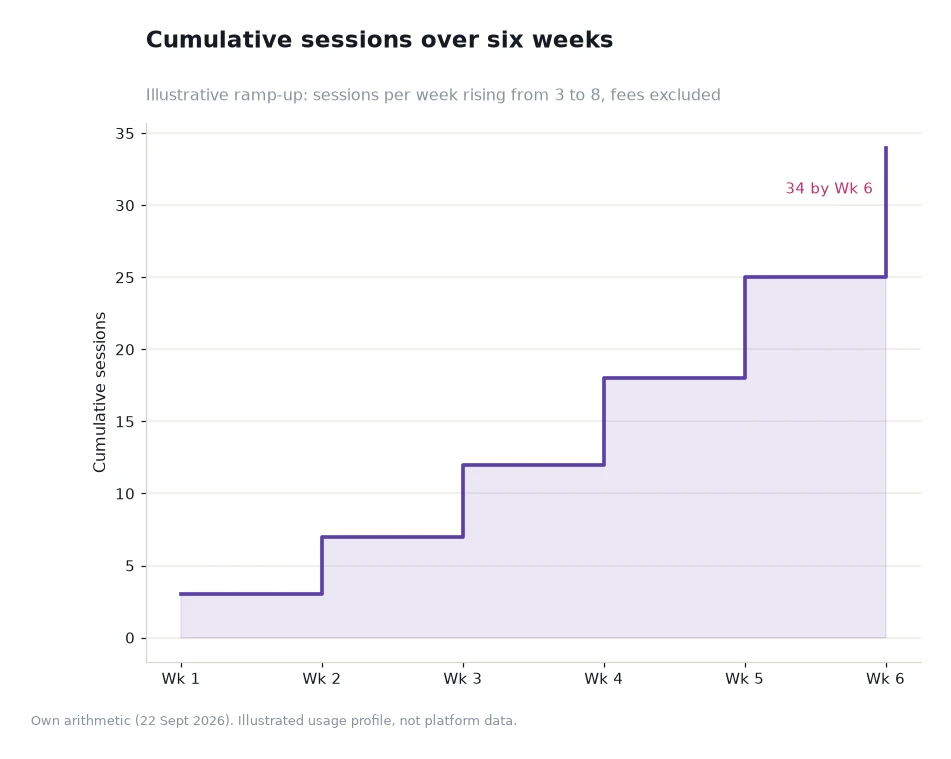
Take an illustrative ramp of cumulative sessions: 3, then 7, 12, 18, 25 and 34 by the end of week six, with weekly additions of 3, 4, 5, 6, 7 and 9. At 15 minutes a session, the totals run 45, 105, 180, 270, 375 and 510 minutes across the six weeks.
The weekly figures are the useful ones: the last three weeks are 90, 105 and 135 minutes, since 6 sessions at 15 minutes is 90, 7 is 105 and 9 is 135. Dividing 510 minutes by six weeks gives 85 minutes a week on average, which is close to an hour and a half - a comfortable moderate budget rather than an extreme one.
That average is the number to write down. It is also worth noting how quickly it moves: the first two weeks total 150 minutes, and the last two total 240, so the same habit needed a 60 percent larger budget within a month. Reviewing the number monthly is what stops the plan from becoming fiction.
Keeping the budget honest
Three habits keep a weekly number meaningful. Track the start and end time of sessions, not the messages inside them. Review the weekly total on the same day each week rather than continuously, because constant checking turns a budget into a scoreboard. And treat two consecutive overruns as information rather than a failure: either the number was wrong or the habit changed shape.
It also helps to know what you are spending the time on. The catalogue rewards a shortlist, so a budget spent across three saved characters usually produces more than the same minutes spread across ten, and building that shortlist through character search takes a single sitting. Readers who want to see what is currently popular before choosing where the minutes go can check the board for ai porn chat, where the platform sets out its Porn Chat AI framing, and pick deliberately instead of by habit.
Reward the plan rather than punishing the overrun. If a week comes in under budget, the surplus is simply not spent, since there is nothing to bank and nothing to make up. If it comes in over, the Monday review is where that gets noticed, and a single overrun usually corrects itself without further intervention. It is repeated overruns that carry information about the number you chose.
What to do when a week is blown by Wednesday is the one case that needs a rule. Decide in advance that the remaining days run at half the normal session length rather than stopping altogether, because stopping turns a budget into a prohibition and prohibitions get abandoned. Half-length sessions still deliver the habit at a fraction of the minutes.
The point of a budget is not restriction. It is to spend the time on the sessions you meant to have, rather than discovering at the end of a month that the habit ran itself.
Frequently asked questions
Should I count sessions or minutes?
Minutes, with sessions as a secondary note. Session counts hide the difference between fifteen minutes and ninety, and that difference is the whole point of a budget.
What if I miss a week entirely?
Start the next week at the normal number. Carrying minutes over is what turns a budget into something to fail at, and it is easy to avoid.
How often should the number be reviewed?
Monthly for light and moderate habits, fortnightly if you are running eight or more sessions a week, because that is where totals move fastest.
Set one number and review it monthly
Log two weeks, divide by two, and write the result down. Check the total weekly rather than continuously, adjust the number once a month, and let each week start fresh. The budget exists to protect the parts of the habit worth keeping, and it takes about five minutes a month to maintain. Adults aged 18 and over are the readers this piece is intended for.
Sources: feature wording and the trend-card counters referenced above were read from Crushon on 22 Sept 2026. The six-week session ramp and the 15-minute session length are illustrative assumptions rather than platform data.[1]