
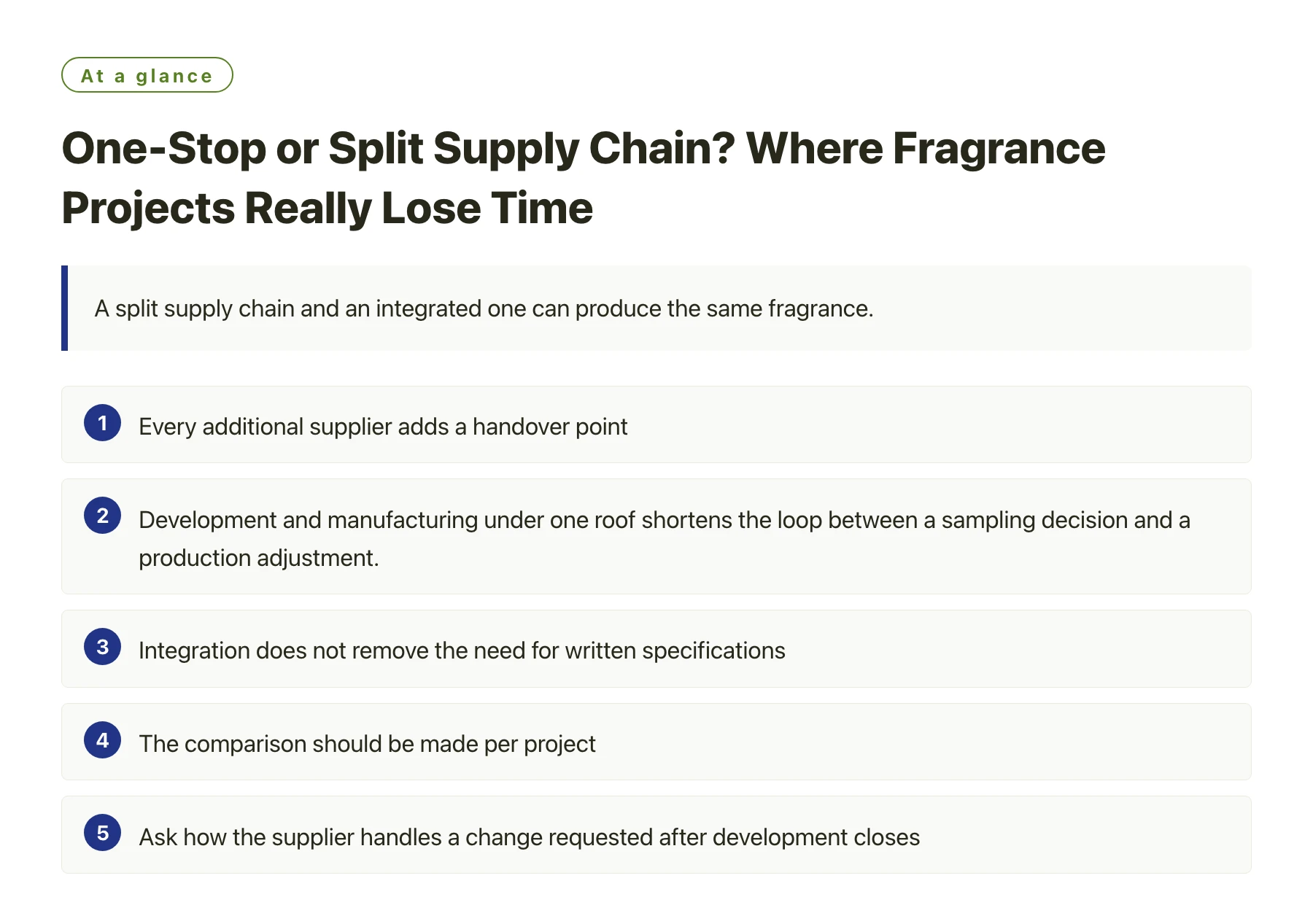
A split supply chain and an integrated one can produce the same fragrance. What differs is how many times the project is re-explained, how many documents have to agree with each other, and who owns a problem that appears at a seam between two suppliers. Integration is worth paying for when a project has several moving parts and a fixed date; it is worth less when the formula is settled and the only remaining task is filling.
Key takeaways
- Every additional supplier adds a handover point, and every handover point is a place where a specification can be interpreted differently.
- Development and manufacturing under one roof shortens the loop between a sampling decision and a production adjustment.
- Integration does not remove the need for written specifications; it changes who is responsible when a specification is ambiguous.
- The comparison should be made per project, because a settled formula needs far less integration than a new line launching several products at once.
- Ask how the supplier handles a change requested after development closes, since that is where integrated and split structures differ most.
A brand developing its first fragrance line usually starts with a formula developer and then looks for someone to fill and pack. Sometimes it happens the other way round. Either route works, and both can produce a good product, but the two structures fail in different places.
The failure is rarely dramatic. It looks like a filling run that used a slightly different carrier ratio, a label that references a specification version nobody else has, or a two-week delay while one supplier waits for an answer from another.
This article compares the two structures on the dimensions that actually affect a project schedule, and lists the questions that establish how integrated a supplier genuinely is, as opposed to how it describes itself. It is written for a brand moving from a single product to a small line, which is the point where handover costs start to matter.
Where a split supply chain adds work
Splitting development from production is not a mistake. It is a deliberate choice that buys access to a specialist formulator, or a filling partner with the right equipment, at the cost of an extra interface.
The cost is administrative rather than technical, and it appears at each point where work moves from one party to the next.
Each handover needs a document that both sides accept
When a formula leaves the developer and enters a filling operation, the receiving team needs the material list, the carrier ratio, the fill specification and the packaging requirements in a form it can work from. If those arrive as a summary in an email, the receiving team fills the gaps with its own assumptions.
That is how a batch ends up technically compliant and commercially wrong at the same time. Nothing was done carelessly; the two teams simply worked to different versions of the same instruction.
The sampling loop gets longer
In a split structure, a change requested after a sampling round travels from brand to developer, back to brand, then to the filling partner, and often back again. Each hop adds a day or a week and a chance for the request to lose detail.
The loop length matters more than it appears, because most projects need more than one adjustment. Small delays compound across rounds, and the compounding is what pushes a launch.
Responsibility at the seam
When a batch problem appears at the boundary, the first conversation is usually about jurisdiction rather than cause. Was the concentrate within specification, or was the filling step out of tolerance? Two suppliers, two sets of records, and a brand in the middle.
This is the strongest argument for integration on complex projects, and it has nothing to do with capability. It is simply cheaper to have one party answer the question.
Split development versus a single integrated partner
| Dimension | Split across two suppliers | Development and production together |
|---|---|---|
| Specification handover | A document must be accepted and re-interpreted by a second team | One specification is used from sampling through filling |
| Change requests after sampling | Travel through an extra party, adding time and interpretation risk | Answered by the same team that built the formula |
| Sampling to production loop | Longer, with more steps between a decision and a new sample | Shorter, because the production constraint is known during sampling |
| Fault attribution at a seam | Requires records from two organisations before a cause is agreed | One organisation holds the concentrate and filling records |
| Packaging and filling input | Often arrives after the formula is fixed, forcing late compromises | Can be considered while the formula is still able to change |
| Flexibility in specialists | Wider choice of formulators and fillers, at the cost of coordination | Narrower choice, with fewer interfaces to manage |
The pattern is consistent: integration buys coordination, and splitting buys specialisation. Neither is automatically cheaper. The useful question is how many interfaces your project can absorb, which is largely a function of how much of it is still undecided.
What integration does not fix
It is easy to oversell the integrated model, so it is worth being precise about its limits. Bringing development and manufacturing under one roof removes interfaces. It does not remove the need for a brief, a specification or a decision.
Projects still fail inside a single supplier when the brand assumes that proximity substitutes for communication.
You still need a written specification
One supplier working from an unwritten understanding is still working from an understanding. The version that matters is the one on paper, because that is the version that can be compared against a batch.
Fragrance houses describe ingredient research and formulation as substantial work in its own right, which is a reminder that the technical detail behind a scent is not something a verbal brief can carry [1].
Adjacent decisions still arrive in sequence
An integrated supplier can consider packaging and filling while the formula is still open, which is a real advantage. It cannot decide the price band, the channel or the launch date for you, and those decisions constrain the technical work in ways the supplier can only respond to.
Sustainability claims are a good example. Ingredient and packaging choices increasingly sit inside the development conversation rather than after it, which is where an integrated structure helps most [2].
Cost is not automatically lower
An integrated partner carries the coordination cost internally and prices it somewhere. Whether that is cheaper than managing two suppliers depends on the size of your project and the time you have to manage the interfaces.
Trade coverage of manufacturing and packaging keeps returning to the same theme: the operational details at the join are where projects are won or lost [3]. That is equally true whether the join is between two companies or between two departments.
Questions that reveal how integrated a supplier is
- Who signs the specification?Ask how many internal parties must approve a specification before production can start, and whether both development and filling work to the same document.
- Who handles a change after development closes?Ask what happens if a material needs to be swapped after sampling is signed off, and who pays for the rework and re-testing.
- Is the packaging decision made before or after the formula?Ask at which point packaging and filling constraints enter the process, because a late entry limits what the formula can still be.
- Where are the batch records kept?Ask whether the concentrate and filling records for one order live in one file, retrievable by a single batch number.
- Which steps are subcontracted?Ask for the list in writing, including any outsourced decoration, filling or packing, because undisclosed subcontracting recreates the seam you were trying to remove.
- How is a complaint handled?Ask who investigates a batch complaint, what the customer receives as a finding, and in what timeframe.
The practical reason to keep R&D and manufacturing in one place is not that one supplier is inherently better than two. It is that a project with an open formula, a packaging decision and a launch date has three things that can change at once, and every additional interface multiplies the ways they can conflict. Count your interfaces before you decide. If your formula is settled and your packaging is chosen, a split structure can be perfectly efficient. If three variables are still moving, integration is usually the cheaper way to keep them moving together.
Sources
- Symrise —— A global fragrance and flavour manufacturer; public information on scent creation, raw materials and research.
- dsm-firmenich —— A global fragrance, flavour and nutrition company; public information on perfumery, ingredients and sustainability programmes.
- HAPPI — Household & Personal Products Industry —— An industry magazine covering the household and personal care market, including fragrance, formulation and packaging.
Frequently asked questions
Is a one-stop fragrance supplier always better than using two?
No. Integration reduces handover work, which matters most on complex or fast projects. A split structure can be better when you need a specialist formulator, or when your formula is already fixed and only filling and packing remain. Decide by counting how many project variables are still undecided.
What does one-stop development usually cover?
It typically spans fragrance development, bottle and packaging design input, filling and packing, with one team responsible from brief to shipped unit. Scope varies by supplier, so ask for a written list of which steps happen in house and which are subcontracted before comparing quotations.
Does an integrated supplier keep my formula confidential?
Confidentiality depends on the agreement rather than on the structure. Put ownership, permitted use, subcontracting and confidentiality obligations in writing before development begins, then confirm what happens to formula documentation, artwork files and tooling if the relationship ends. A single supplier is easier to bind contractually, but only if the contract actually says so.
How do I compare an integrated quote with two separate quotes?
Add the cost of coordination to the split option: your own management time, the extra sampling rounds, the shipping between the two parties and the risk of rework at a handover. Then compare the totals on an identical scope, including packaging and filling. Comparing an all-in quotation against two partial quotations is the most common way this decision is made incorrectly.
Can I move production to a different partner later?
It depends on what you hold. If you own the formula and the specification documentation, moving is a project rather than a restart. If the formula documentation stays with the developer, your options are narrower. Settle this question before the first order rather than after the third.